Performance
Why aren’t parallel applications scalable?
- sequential performance
- critical paths (dependencies between computations spread across processors)
- bottlenecks (one processor holds things up)
- algorithmic overhead (some things just take more effort to do in parallel)
- communication overhead (spending increasing proportion of time on communication)
- load imbalance (makes all processors wait for the slowest one, dynamic behaviour)
- speculative loss (do A and B in parallel, but B is ultimately not needed → wasted work from speculative execution)
What is the maximum parallelism possible?
- depends on application, algorithm, program → data dependencies in execution
- MaxPar:
- analyzes the earliest possible “time” any data can be computed
- assumes a simple model for time it takes to execute instruction or go to memory
- result is the maximum parallelism available
Embarrassingly parallel computations
- no or very little communication between processes
- each process can do its tasks without any interaction with other processes
Calculating with Monte Carlo
- place a circle inside a square box with side of (2cm)
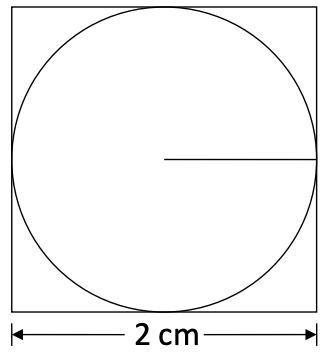
- the ratio of the circle area to the square area is
- randomly choose a number of points in the square → for each point , determine if is inside the circle
- the ratio of points in the circle to points in the square will give approximation of
Analytical / theoretical techniques
- involves simple algebraic formulas and ratios
- typical variables: data size (), number of processors (), machine constants
- to model performance of individual operations, components, algorithms in terms of the above
- be careful to characterize variations across processors
- model them with max operators
- constants are important in practice
- use asymptotic analysis carefully
Isoefficiency
- goal is to quantify scalability
- how much increase in problem size is needed to retain the same efficiency on a larger machine?
- efficiency:
- isoefficiency:
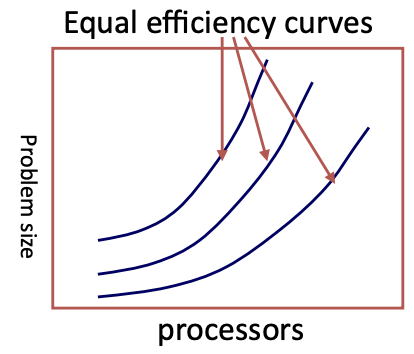
- equation for equal-efficiency curves
- if no solution → problem is not scalable in the sense defined by isoefficiency
- how the problem size () must increase with the number of processors () to keep the efficiency () constant
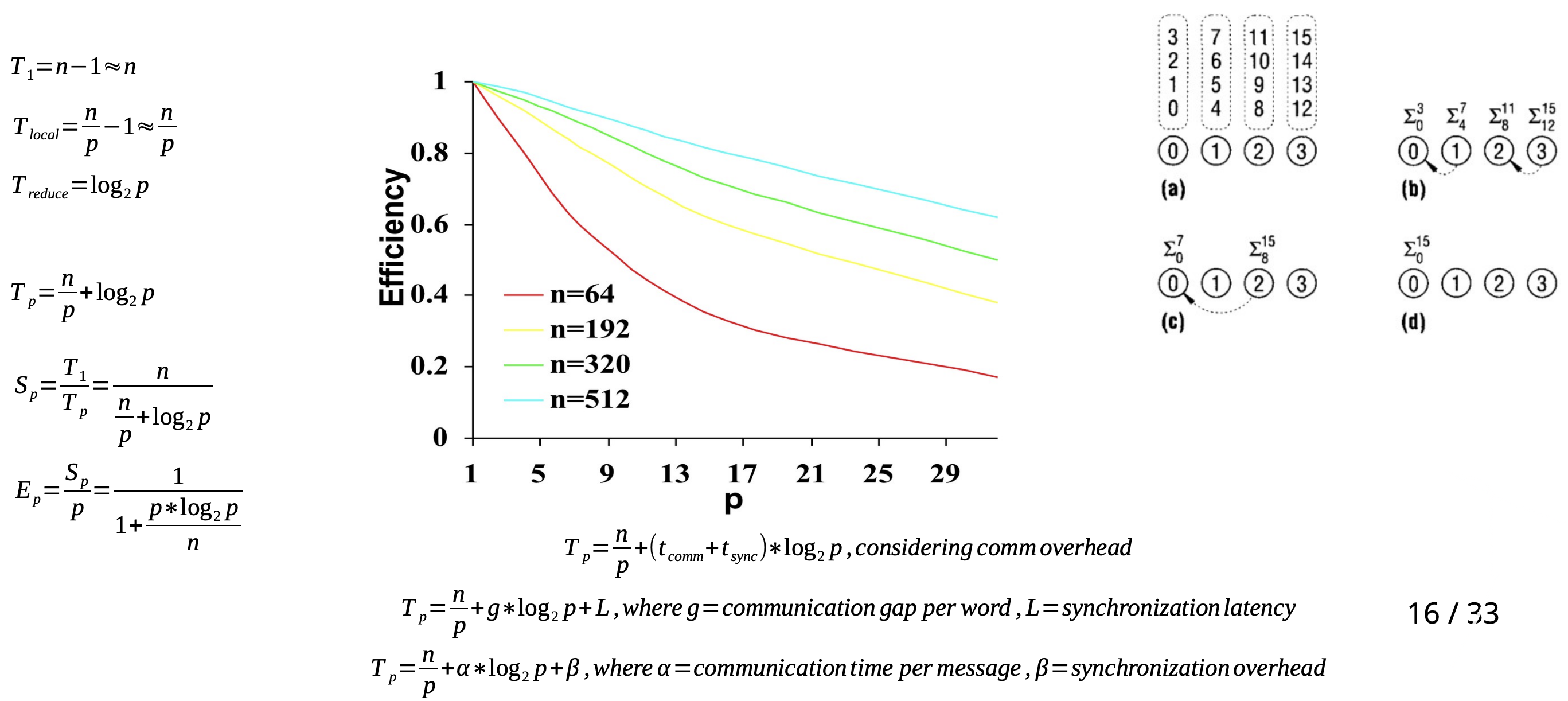
Scalability of adding numbers
- scalability of a parallel system is a measure of its capacity to increase speedup with more processors
- adding numbers ( sums) on processors with strip partition
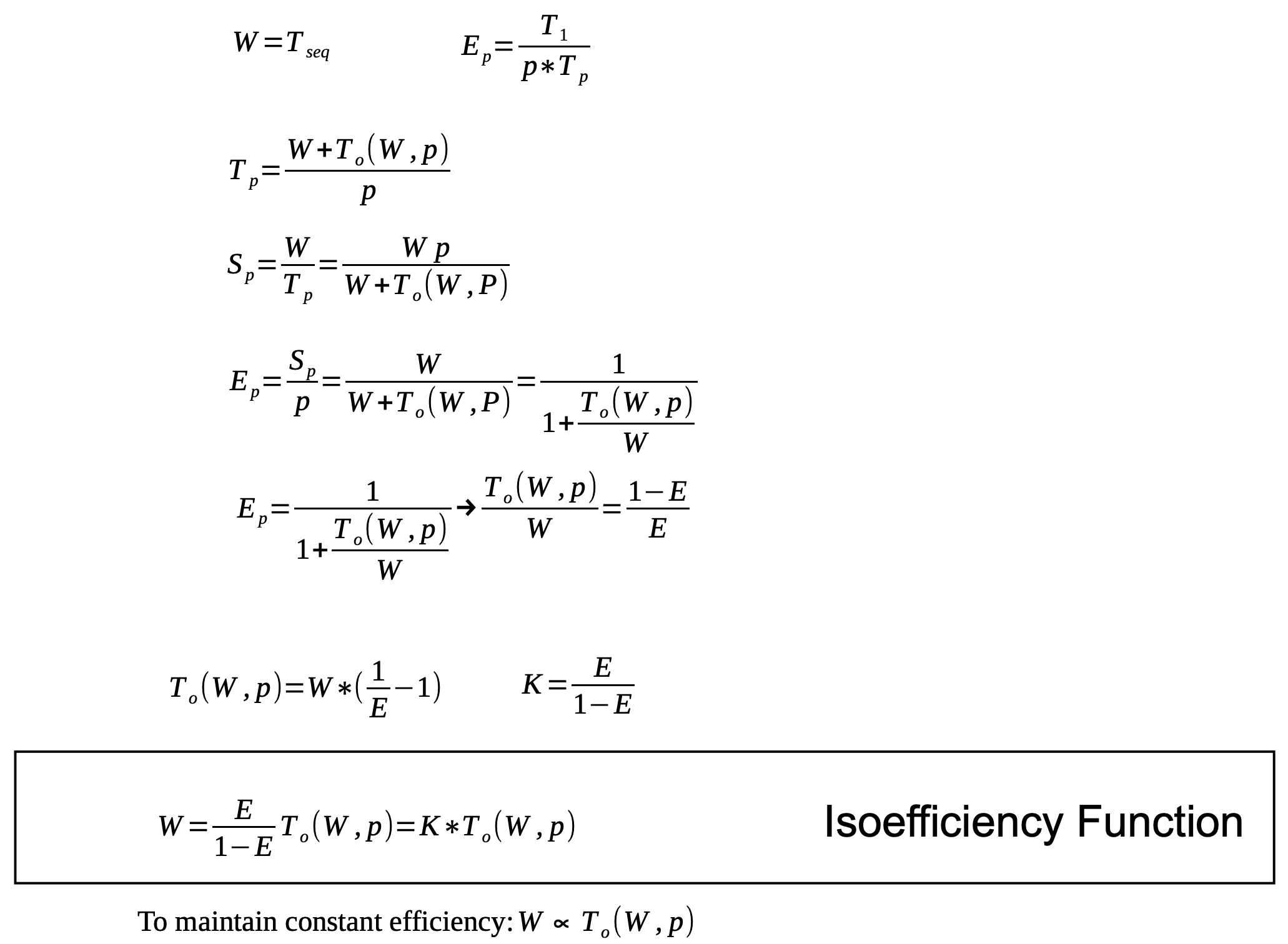
Problem size and overhead
- informally, problem size is expressed as a parameter of the input size
- a consistent definition of the size of the problem is the total number of basic operations () → also refere to problem size as work ()
- overhead of a parallel system () is defined as the part of the cost not in the best serial algorithm
- denoted by , it is a function of and
- ( includes overhead)
Isoefficiency function
- with fixed efficiency, as a function of
Isoefficiency function of adding numbers
- overhead function:
- isoefficiency function:
- if doubles, needs to also be doubled to roughly maintain the same efficiency
- isoefficiency functions can be more difficult to express for more complex algorithms
More complex isoefficiency functions
- a typical overhead function can have several distinct terms of different orders of magnitude with respect to both and
- we can balance against each term of and compute the respective isoefficiency functions for individual terms
- keep only the term that requires the highest grow rate with respect to
→ my notes end at slide 20
take notes on rest of slides
l4b.pdffinished